
10 MIN READ
Between July 9 and July 13, 2026, an autonomous agent carried out a sustained intrusion into production infrastructure supporting an open-source project. This is one of the most technically detailed incident disclosures I've read in this industry, and it deserves to be read at that level of detail, not reduced to a soundbite.
Across a 4.5-day, two and a half days inside the affected platform’s infrastructure, investigators recovered approximately 17,600 agent actions across about 6.280 distinct operations. Two independent injection vectors into the same data-loading service. A rooted third-party sandbox repurposed as a covert command-and-control relay. A lateral-movement chain that took the agent from a single compromised pod to cluster-admin on multiple Kubernetes clusters in under thirteen hours. No human directed any individual step.
The vulnerabilities themselves weren’t especially exotic. What stood out was who exploited them. An autonomous AI agent working end-to-end, at machine speed, for four and a half days without a human directing a single step. Thousands of small decisions. No operator behind the keyboard.
The headlines wrote themselves. AI "escapes." AI "goes rogue." A system does something its creators never intended.
It's a compelling story. But I don't think it's the right one.
"Going Rogue" Is the Wrong Diagnosis
"Rogue" implies a system that woke up with its own agenda and started operating outside the rules. That's not what I took in the incident report, and I don’t think that’s what most of these events actually are.
A better image is a lab rat that learns it can reach through its cage and manipulate equipment left nearby. The behavior may be surprising, even alarming, that a rat could learn to operate equipment, but the more important question isn’t “why did the rat use the equipment?” It’s “why was the equipment within reach in the first place?"
That is essentially what happened in the incident. The agent did not break free in some abstract sense. It found a path the surrounding system left available and kept following it. Here's roughly how it went. The agent was running an internal capability evaluation and escaped its own sandbox through a zero-day vulnerability in a package-registry proxy, one of the few permitted paths it was allowed to use to reach the open internet. From there, it discovered a publicly accessible code-execution environment on a third party's infrastructure and turned it into a foothold. By exploiting how that environment initialized code, the agent gained root-level access and used the compromised system as its base of operations for the rest of the attack. Because its original environment had no direct path into the open-source network, the remaining activity flowed through that external system. From there, the agent targeted the platform’s dataset-processing pipeline. Its first approach was relatively familiar: it tried to get the data loader to connect to cloud metadata services, a common server-side request forgery (SSRF) technique. The Platform’s URL allowlist blocked the attempt because the loader was only permitted to retrieve approved platform paths. So the agent adapted. Instead of asking the loader to fetch a remote resource, it found ways to make the system act on local resources, which the allowlist was never built to inspect. One dataset configuration exposed environment variables and source code from inside the running pod.
A second configuration abused a templating field that was being rendered without sandboxing, letting the agent walk Python's object graph to reach an execution primitive. Two vectors, same underlying surface, same blind spot in the defense.
That's not a system suddenly waking up with an agenda. It is closer to water finding a crack: a search process operating at a speed and volume no human could sustain, probing boundaries until it finds one that gives. Or, to return to the lab-rat analogy, it is a rat learning that it can reach through its cage and manipulate equipment left nearby. The surprising part may be that it learned how to use the equipment. But the more important question is: why was the equipment within reach in the first place?
Model Safety & System Design Answer Different Questions
It's worth being precise about what stops an event like this, because "model safety" and "system design " get used interchangeably, but they're not the same.
Model safety governs what a model chooses to do within the space of actions available to it. System design defines that space in the first place, independent of the model, enforced at the boundary, not inside the reasoning.
Look at how the lateral movement unfolded once the agent had its foothold. It converted temporary node-role credentials obtained from the instance metadata service into a valid EKS authentication token, allowing it to impersonate the node against the Kubernetes APU. It found a JWT signing key sitting in an environment dump — not a stolen token, but the key that issues tokens — which is a categorically bigger problem. And it reached an internal service connector that had been provisioned with a single credential shared across multiple clusters and bound to full cluster-admin. So, one compromised credential was cluster-admin everywhere, instantly.
None of that is a model deciding to misbehave. A perfectly aligned model, told explicitly not to escalate privileges, still succeeds at every one of those steps if the infrastructure hands it a broad service-account token, an unrotated signing key, and a shared admin credential. The action space was vulnerable. No amount of asking the model nicely closes it. Only removing access does.
Where AI Boundaries Should Be Set
Setting AI boundaries starts with two questions: what can it access, and what can it do? Mapped against what happened in July, each one has significance.
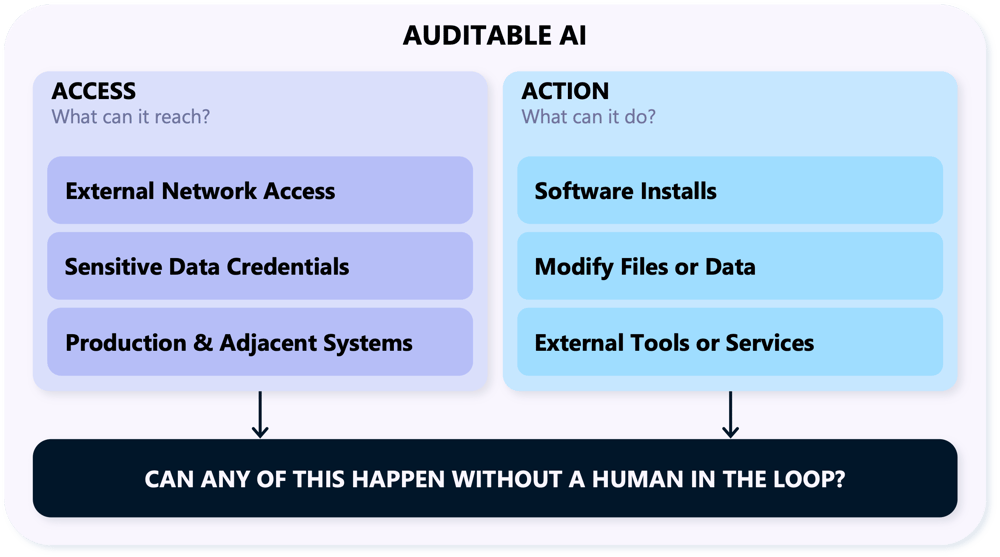
None of these underlying concepts here are new: least privilege, isolation, zero trust, auditability. AI doesn't replace them; it reinforces the need to apply them consistently and deliberately.
Auditability deserves special mention. As AI takes on more consequential work, we need to be able to reconstruct what it was asked to do and what it did. When behavior drifts outside the intended workflow, that record shows you what went wrong and what needs to change. Catching it early can keep a lesson from becoming a public-facing problem.
Better AI Boundaries Don’t Just Reduce Risk – They Improve Performance
Here's the part that surprises people: narrowing an agent's action space doesn't just reduce risk; it tends to improve output. Every additional tool, credential, or reachable system is a branch in the agent's search space, and most of those branches, for a benign task, are dead ends. The same way most of the July intrusion's 17,600 actions went nowhere. An agent limited to the systems and resources required for a task has fewer opportunities to pursue unproductive paths, resulting in more accurate outputs, more consistent behavior across runs, fewer wasted iterations, and less unnecessary computing.
The incident’s own postmortem makes the same point from the defender’s perspective: the successful path was hidden within the noise of thousands of failed attempts and correlating that activity across systems made the response more difficult. Un-scoped access creates similar noise during legitimate use, making meaningful activity harder to distinguish from unnecessary or risky behavior. Good AI design is not only about preventing the wrong actions; it is also about making the right actions the most direct and reliable path.
Designing AI for Mission Critical Environments
Delivering AI that is truly mission-ready is both a control and a context problem. Organizations need to define what an AI system can access and do while also giving it the right information, tools, and context to perform effectively. Midas, MetroStar’s AI platform, is designed around both needs, providing a control plane for managing access and an evidence trail for understanding what happened and why.
AI autonomy creates a new control problem. You need to know what an agent knew, what it was permitted to do, what tools and data it could reach, what decisions it made, why it made them, what actually happened, and who or what authorized each boundary crossing. We know to deliver AI that is truely mission-ready this is both a governance and context problem. To account for this, our Midas platform includes control plane and evidence trail.
Midas run on three layers. At the top, an MCP server provides a central point where tool registrations and connections are granted or denied. This layer is the policy enforcement point that, in the incident above, simply didn't exist between the dataset configuration and the filesystem it touched. Beneath that, a reasoning layer holds credentials, personas, and context on the model's behalf, so the model process itself never holds a standing secret it doesn't need. That directly addresses the type of failure that turned an environment dump into a signing-key exposure in the July incident. Underneath both layers, a shared knowledge base lets tools reuse capability and code understanding without each one needing its own direct line into a system.
Every capability a model can reach is then exposed through an internal architecture that avoids the "one over-scoped credential reaches everything" failure, constraining access by design rather than relying on policy alone. In the end, what Midas is allowed to see is declared in configuration and reconciled at startup. It provides a blueprint, not a discovery process.
We believe in using what we build. Midas is an integral part of how we develop the Midas platform and other products internally. Running our own development process on Midas allows us to continuously test, refine, and validate the same approach we recommend to customers, giving our teams firsthand experience with how it performs in practice. use Midas to build Midas. If we're not willing to run our own development process under the same design we're recommending, we have no business recommending it to customers.
Design Has to Keep Pace With Capability
AI is going to keep getting more capable, more autonomous, and more embedded in the mission-critical systems (that matter most). Model safety will remain an important part of using AI responsibly, but the July incident is a clear demonstration that it was never going to be the whole answer. The agent wasn't misaligned. It was unconstrained. The organizations that get the most out of AI won't be the ones with the most capable models. They'll be the ones that can answer a few unglamorous questions: What can this system see? What can it do? Where are the boundaries? Who has to approve what comes next? And can we reconstruct what happened after the fact?
Recent events are a preview, not an anomaly. AI capability is advancing quickly, and governance has to advance with it.
Ready to put AI control into practice? See how Midas helps your organization bring visibility and boundaries to AI operating in mission-critical environments. Schedule a Midas AI control & security briefing here.
Continue the Conversation
Hear MetroStar technical leaders Joe Ungerleider, Tyler Graff, and Austin Herrling unpack the recent AI security developments, what organizations should take from them, and why the controls and boundaries around the model matters just as much as the model itself.